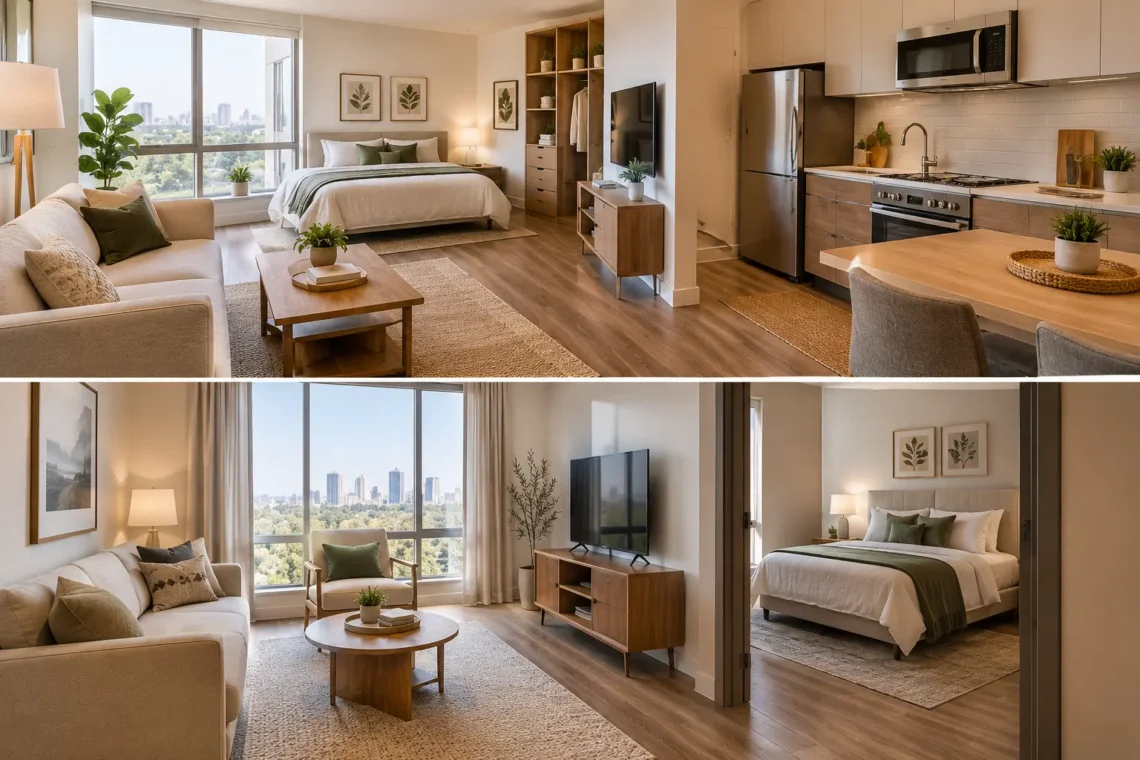
Picture this: you walk into a small apartment after a long day. Your sofa sits a few steps beside your bed, the kitchen is tucked along one wall, and every item has a place. It feels cozy, simple, and manageable.
Now picture another apartment with a door separating the bedroom. You can shut that door after bedtime, leave the living room tidy for guests, and keep work, sleep, and relaxing in different spaces.
Both homes can feel great. The real question is how you live.
If you have been searching what is a studio apartment, you are probably deciding if one open room can suit your daily routine. A one-bedroom apartment offers more separation, but that extra space may not always be worth the higher rent or added cleaning.
This guide breaks down the difference between 1 bedroom and studio, looks at typical studio apartment size ranges, and helps you choose a layout that fits your routine rather than just a floor plan.
What Is a Studio Apartment?
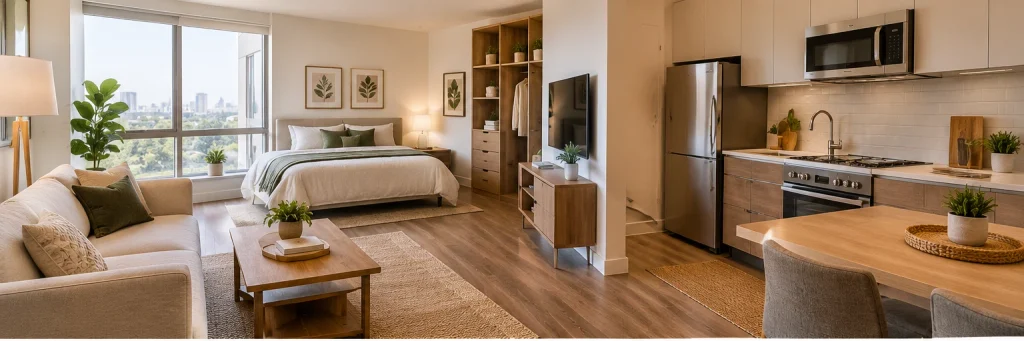
A studio apartment is a home where the main living, sleeping, and often dining areas share one open room. The kitchen may sit along one wall, occupy a small corner, or have a partial divider. The bathroom usually has its own enclosed space.
The U.S. Census Bureau describes an efficiency or studio as a one-room apartment with no room designated specifically for sleeping. HUD materials also use the term studio for units where the bedroom and living area share the same room.
So, what is a studio apartment in everyday life? Think of it as one flexible room that changes purpose throughout the day.
In the morning, one corner can act as a bedroom. At lunch, the same area can feel like a dining space. In the evening, your sofa becomes the main place for relaxing.
That open setup is the biggest feature of a studio. It can also be its biggest challenge.
What Is the Difference Between a Studio and a One-Bedroom Apartment?
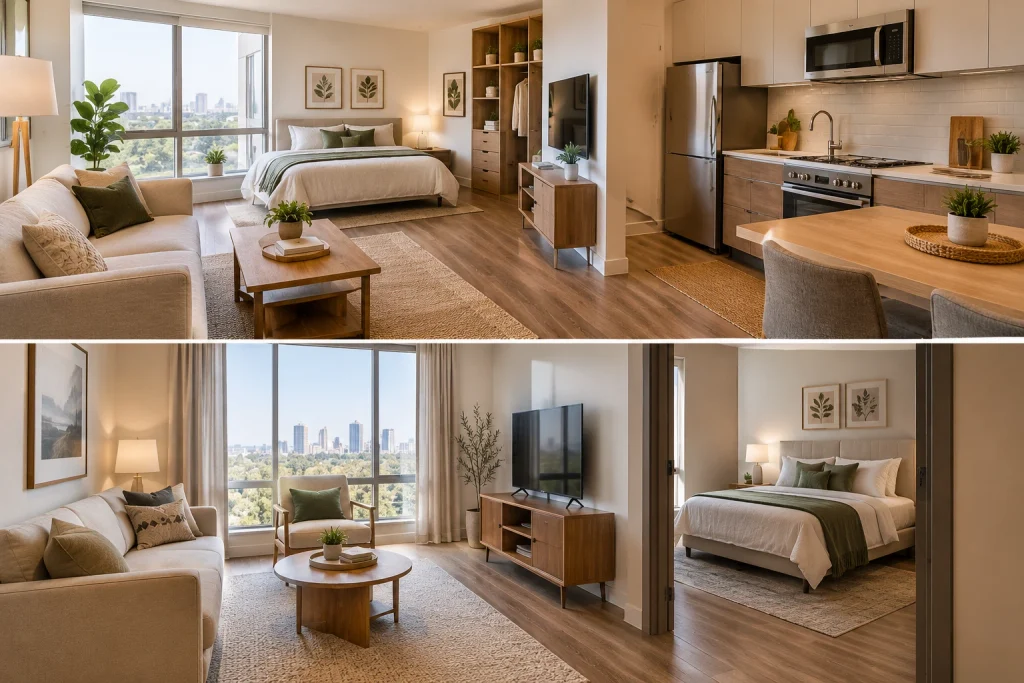
The clearest difference is simple: a one-bedroom apartment has a separate bedroom, while a studio usually does not.
A one-bedroom layout normally has a living area, kitchen, bathroom, and an enclosed bedroom. The bedroom may have a door, window, closet, and enough floor area for a bed plus storage.
A studio keeps the sleeping area within the main living space. Some studios use shelves, curtains, half walls, or furniture as visual dividers, but the sleeping zone remains part of the open room.
Here is a quick comparison:
| Feature | Studio Apartment | One-Bedroom Apartment |
|---|---|---|
| Sleeping area | Open within main room | Separate enclosed room |
| Living area | Shares the main space | Separate living space |
| Privacy | Limited | Higher |
| Furniture needs | Compact pieces work best | More flexibility |
| Cleaning | Usually quicker | More rooms need cleaning |
| Guest experience | Bed may be visible | Bedroom can stay private |
| Storage | Often more limited | Usually more room |
| Best fit | Solo living, simple routines | Solo living or couples needing separation |
The difference may sound small on paper, but it can change how your home feels every day.
How Big Is a Studio Apartment?
People often ask, how big is a studio apartment? The honest answer is that size varies widely across cities, buildings, layouts, and local rules.
There is no single worldwide size that makes a home a studio. One HUD document, for example, describes an efficiency apartment at 450 heated square feet and a studio at 375 heated square feet for a specific housing program and construction context. Those figures should not be treated as a universal rule for every apartment market.
For everyday apartment hunting, you may see studios that feel quite compact, while others have enough room for a full sofa, dining table, work desk, queen bed, and generous storage.
The layout matters almost as much as the number on the listing.
A 450-square-foot studio with large windows, good storage, and a smart kitchen can feel more comfortable than a poorly planned 550-square-foot unit.
Average Size of Studio Flat: What Should You Expect?
The phrase average size of studio flat can be tricky because rental markets do not use one shared measurement standard.
Instead of chasing one perfect average, look at:
- Total square footage
- Shape of the main room
- Closet space
- Kitchen footprint
- Bathroom placement
- Window size
- Ceiling height
- Door and hallway placement
- Built-in storage
- Space for a desk or dining table
The studio apartment size shown on a listing tells only part of the story. A simple floor plan can reveal much more.
What Makes One-Bedroom Apartments Feel Different?
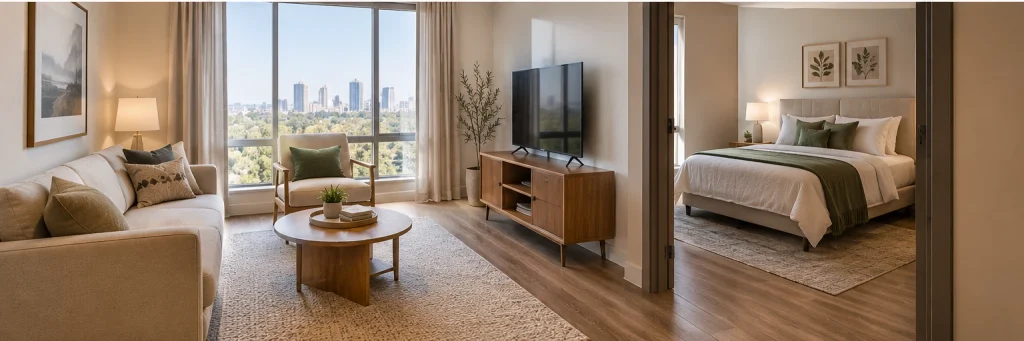
One bedroom apartments can feel noticeably more private even when the total floor area is not dramatically larger.
The bedroom creates a clear boundary. You can close the door when you sleep, work in the living room without looking at your bed, or host a friend while keeping personal items out of sight.
That separation can also make furniture planning easier.
You might place a proper bed, bedside tables, and a wardrobe inside the bedroom. The living room can then hold a sofa, coffee table, TV unit, reading chair, or desk without competing with the bed.
For someone working remotely, that division can be especially useful. The bedroom becomes a sleep zone while the living room carries the daytime activity.
A one-bedroom apartment may also make sense for couples who want different schedules. One person can read or watch TV while the other sleeps behind a closed door.
Whats a Studio Apartment Like for Daily Life?
If you are asking whats a studio apartment really like, imagine living with fewer visual boundaries.
That does not mean the home needs to seem messy. It means the furniture has a bigger role in creating clear zones.
A rug can mark the lounge area. A narrow bookcase can create a visual break between the bed and sofa. A console table can act as a soft divider. A curtain can hide the bed when guests arrive.
A Real-Life Example
Imagine Maya, a young professional who spends most weekdays at work. She returns home, cooks a simple meal, watches a show, reads for a while, and sleeps.
She does not need a large dining room or a separate guest room. A studio gives her enough room for a comfortable bed, compact sofa, small dining table, wardrobe, and work desk.
Now imagine Daniel, who works remotely and often has friends visit.
His bed sitting beside his desk and sofa may make the room feel like one large work-and-sleep zone. A one-bedroom apartment gives him a separate place for sleeping and a more polished living room for guests.
Neither choice is automatically better. The better fit depends on routine.
Is a Studio Apartment Cheaper Than a One-Bedroom?
In many rental markets, studios can have a lower monthly rent than one-bedroom units, but price gaps vary heavily with location, building amenities, demand, and floor area.
A smaller rent can make a studio attractive for someone who wants to keep monthly housing costs under control.
There can also be savings in other areas. A smaller home may need less furniture, fewer décor pieces, and less time for cleaning.
Still, a cheaper apartment is not always the better deal.
Suppose a studio saves you a modest amount each month but leaves you frustrated because you work at home, own bulky furniture, or need a private sleeping room. That lower rent may not feel like a win after several months.
Before choosing, compare the total monthly cost and the way you actually use your home.
Studio Apartment vs One-Bedroom: Which Is Better for Furniture?
Furniture can make or break a small apartment.
A studio rewards pieces that serve more than one purpose.
Good choices include:
- Storage beds
- Nesting tables
- Slim sofas
- Folding dining tables
- Wall-mounted shelves
- Ottomans with hidden storage
- Narrow bookcases
- Drop-leaf desks
- Lightweight chairs that can move easily
A large sectional may look beautiful in a showroom but overwhelm a compact studio.
One-bedroom homes give you more freedom. You can choose a larger sofa without worrying as much about the bed competing for the same floor area. You can also keep bedroom furniture separate.
If interior style matters for you, study the visual path across the home. In a studio, every major piece is visible at once. Matching materials, repeated textures, and a simple color palette can make the room feel calmer.
How Can You Make a Studio Feel Like Separate Rooms?
You can skip walls since your apartment has one open room.
Try simple zoning ideas first.
Use a Rug
Place a rug under the sofa and coffee table. This creates a visual living-room boundary without blocking light.
Position the Bed Carefully
Place the bed away near the main entrance if the floor plan allows it. A bed that is not immediately visible can make the apartment feel more private.
Add an Open Shelf
An open bookcase can divide sleeping and living zones while still letting light pass through.
Try a Curtain
A ceiling-mounted curtain can hide the sleeping area when needed. Choose a fabric that suits the room instead of making the divider feel like an afterthought.
Use Lighting
A floor lamp near the sofa, bedside lighting, and a small kitchen light can give each zone its own mood.
These changes can make a studio feel intentional rather than simply small.
What Should You Check Before Choosing a Studio?
Knowing what is a studio apartment is only the first step. Seeing the actual space matters much more.
When visiting a unit, walk through your normal day.
Ask yourself:
- Where will I put my bed?
- Can I fit the sofa I already own?
- Is there room for a desk?
- Where will coats, shoes, and bags go?
- Can I keep the kitchen visually separate?
- Will guests have to sit beside my bed?
- Is the storage enough for my clothes?
- Does natural light reach most of the main room?
- Is the bathroom placement convenient?
- Will the layout still work if I add one more piece of furniture?
If possible, bring a measuring tape or check the floor plan carefully.
Square footage can look impressive in a listing, but awkward corners, narrow passages, and poorly placed doors can reduce usable space.
Is a 1 Bedroom Better for Couples or Remote Workers?
A 1 bedroom can be a strong choice for people who need separation during the day.
For couples, the private bedroom gives each person a clearer sleep space. For remote workers, the living room can become an office without turning the bed into part of the work setup.
That said, a studio can still work for two people when both have similar schedules, own fewer belongings, and are comfortable sharing one open area.
The key issue is not simply the number of people. It is how those people use the home.
HUD guidance also shows why bedroom count and household needs should not be treated as a one-size-fits-all formula. Occupancy rules can depend on local requirements, unit size, and other circumstances.
Difference Between 1 Bedroom and Studio: Which One Fits You?
The difference between 1 bedroom and studio becomes easier when you focus on your habits.
Choose a studio if you:
- Live alone
- Prefer a simple home
- Own fewer belongings
- Like open layouts
- Want less cleaning
- Need a lower-cost housing option in your market
- Do not mind seeing the bed while relaxing or hosting guests
A one-bedroom may suit you better if you:
- Work at home
- Live with a partner
- Want stronger privacy
- Host guests often
- Own larger furniture
- Need a quieter sleep area
- Want separate zones for work and rest
There is also a middle ground. Some studios have clever alcoves, partial walls, or sleeping nooks that create a bedroom-like feeling without a fully enclosed room.
When you compare 1bedroom apartments with studios, look past the label. Study the floor plan, storage, windows, noise level, and usable floor area.
What Is a Studio Apartment and Is It Right for You?
So, what is a studio apartment? It is a compact home where the main living and sleeping functions share one open room, usually with a separate bathroom and kitchen area.
The appeal is easy to understand. Studios can feel cozy, simple, and efficient. They can suit people who prefer less clutter and do not need many separate rooms.
A one-bedroom offers a different kind of comfort. Its biggest advantage is separation. You can close a bedroom door, keep the sleeping area private, and give your living room its own purpose.
Neither layout wins every time.
Think about your morning routine, work schedule, furniture, storage needs, guests, and long-term comfort. Then compare those needs with the actual floor plan rather than choosing based only on a listing label.
If you are styling a smaller home, Turner Home Decor can help you find décor ideas that make compact spaces feel warm, organized, and personal.
Helpful Housing Resources
For general housing terminology and official guidance, these resources are useful:
- U.S. Census Bureau housing definitions — official terms for housing units, bedrooms, and efficiency apartments.
- U.S. Census Bureau multifamily housing glossary — useful housing terminology and bedroom definitions.
- U.S. Department of Housing and Urban Development — official occupancy and housing guidance.
- HUD housing occupancy guidance — information about unit size, bedrooms, and occupancy policies.