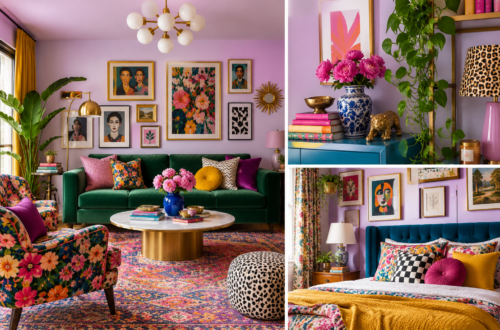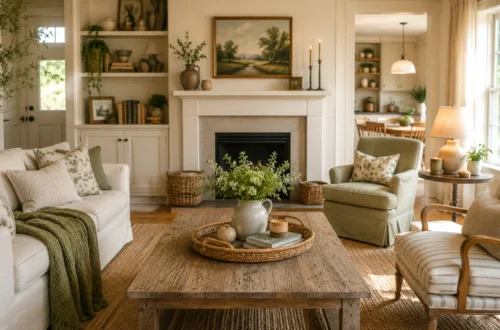
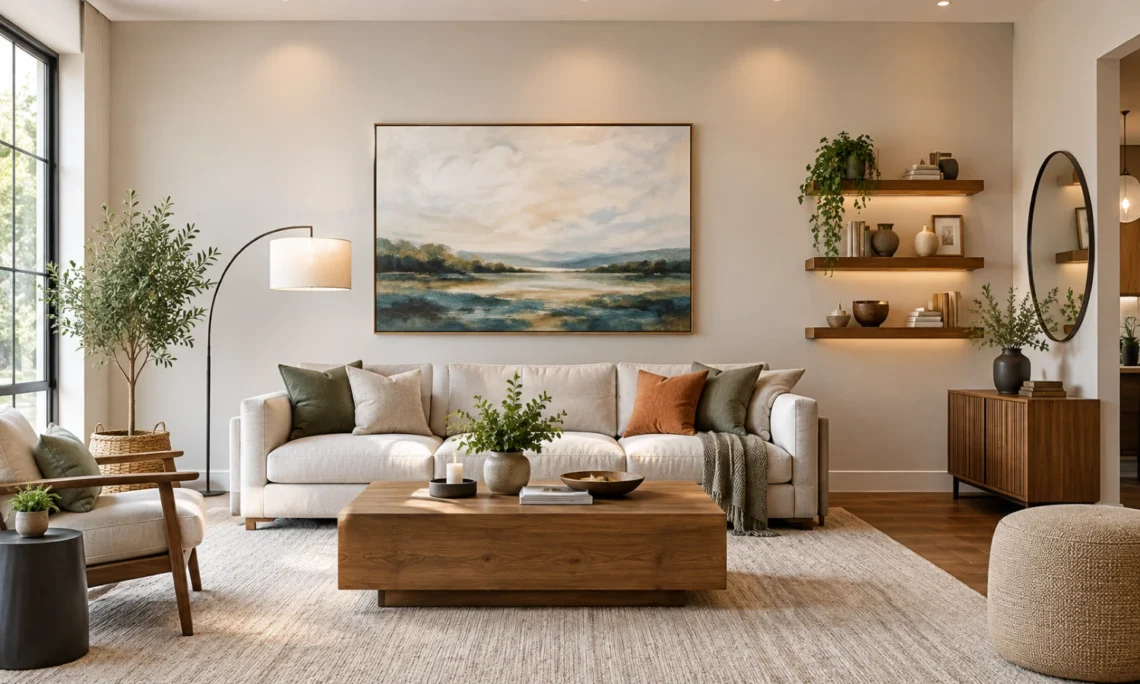
A large blank wall can be one of the most exciting features in a home—and one of the most difficult to decorate.
The amount of available space often creates pressure to fill it. Homeowners may start adding artwork, shelves, mirrors, plants, photographs, and decorative objects simply because the wall still appears empty. Before long, a wall that once felt unfinished can become the busiest part of the room.
The solution is not necessarily to add more. A large wall usually needs the right amount of visual weight, a clear focal point, and a strong relationship with the furniture around it.
Whether the wall sits behind a sofa, above a bed, along a dining area, or in an open living space, the following principles can help turn it into an intentional part of the room without overwhelming the interior.
Decide What the Wall Needs to Accomplish
Before buying anything, determine the purpose of the wall.
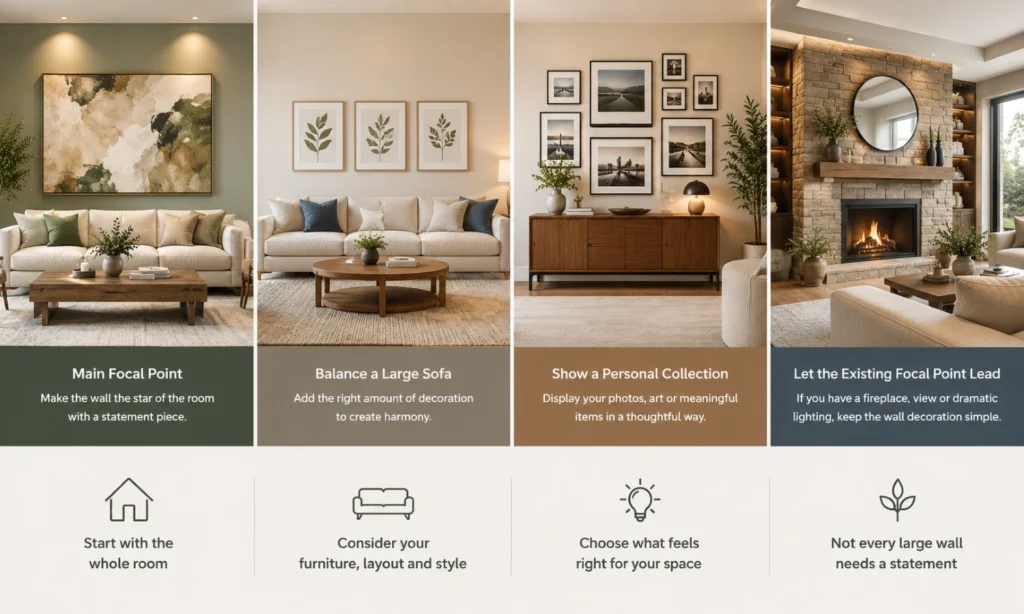
Does it need to become the main focal point of the room? Does it simply need enough decoration to balance a large sofa? Are you trying to display a personal collection? Or does the room already have a strong focal point elsewhere?
These questions matter because not every large wall should become a statement wall.
If the room already contains a fireplace, dramatic lighting, patterned furniture, or a beautiful view, the blank wall may need only a restrained decorative element.
In a simpler room, however, that same wall can become the ideal place for a large-scale artwork or a carefully planned arrangement.
Start with the room as a whole rather than the wall in isolation.
Use the Furniture as Your Starting Point
One of the easiest ways to make a large wall manageable is to stop thinking about its total dimensions.
Instead, look at the furniture positioned against it.
A sofa, bed, console, sideboard, or dining table establishes a natural visual zone. The wall decoration should usually relate to that zone rather than attempting to occupy the entire wall.
Imagine a 15-foot-wide wall with an 8-foot sofa. Decorating all 15 feet can create an unnecessarily large composition. Designing primarily around the sofa produces a much clearer relationship between the furniture and artwork.
This also prevents artwork from appearing as though it is floating independently on a huge surface.
Furniture gives the wall a reference point—and makes decisions about scale much easier.
Consider One Large Statement Piece
A single substantial piece of artwork is often the simplest solution for a large blank wall.
It provides visual impact without requiring numerous objects, frames, or accessories. It can also make a room feel calmer because the eye has one clear focal point rather than several competing ones.
Large canvases work well for this purpose, as do oversized photographs, textile art, and dimensional pieces. In modern and contemporary interiors, large metal wall art can be particularly effective because its shape, depth, and shadows create visual interest while maintaining a relatively clean composition.
The important point is not the material itself but the relationship between the artwork and the surrounding room.
An oversized piece should feel substantial enough to relate to the furniture without extending so far that it visually crowds nearby windows, doors, lighting, or architectural details.
Get the Scale Right Before You Buy
Large walls can be deceptive.
Artwork that appears substantial in a store or online may look surprisingly small once placed above a long sofa or king-size bed.
For that reason, measurements should come before purchasing.
Measure the furniture width, the available wall area, the ceiling height, and any nearby architectural features. Then mark the proposed artwork dimensions directly on the wall with painter’s tape.
This simple technique gives you a much more realistic understanding of scale than trying to visualize dimensions from a product listing.
If you are uncertain about proportions, reviewing a practical guide to choosing the right wall art size can help establish a starting point before committing to a large piece.
Do not focus only on width. Height matters too, particularly in rooms with tall ceilings.
A wide but very short artwork may still leave a tall wall feeling visually empty. Conversely, an extremely tall piece can dominate a room with standard ceilings.
Create a Gallery Wall With Clear Boundaries
One oversized artwork is not the only solution.
A gallery wall can turn a large surface into a personal collection of photographs, prints, illustrations, and artwork. However, successful gallery walls require more planning than simply adding frames until the wall looks full.
Begin by defining the approximate outer boundary of the entire arrangement.
Within that boundary, use consistent spacing to create order. Frames do not have to match, but some form of repetition—such as color, material, subject matter, or alignment—helps individual pieces feel connected.
Arrange everything on the floor before hanging it. Another option is to cut paper templates matching each frame and tape them to the wall.
This allows you to adjust spacing and composition without making unnecessary holes.
Most importantly, know where the gallery wall ends. A clearly defined collection feels intentional. An arrangement that gradually spreads into every available area can quickly become cluttered.
Try a Pair or Triptych
There is a useful middle ground between one oversized artwork and a full gallery wall: two or three coordinated pieces.
A diptych or triptych can cover substantial horizontal space while maintaining structure and repetition.
This approach works particularly well above sofas, beds, dining tables, and long consoles.
Spacing is important. If the pieces are too far apart, they begin to look unrelated. When positioned with consistent gaps, the eye reads them as one larger composition.
Multiple panels can also be easier to transport and install than one extremely large piece while creating similar visual presence.
Introduce Texture Instead of More Objects
A large wall does not always need more color or more decorative items. Sometimes it simply needs texture.
Woven wall hangings, sculptural artwork, natural materials, wood panels, dimensional surfaces, and metal pieces can create depth through light and shadow.
This is particularly useful in neutral rooms.
A beige, cream, white, or gray interior can remain visually calm while gaining character through materials with different textures.
Texture also changes throughout the day as natural and artificial light moves across the surface. Dimensional artwork may appear subtle in flat daylight and more dramatic when illuminated from the side in the evening.
This can make a simple wall composition feel dynamic without adding clutter.
Use Shelving Selectively
Floating shelves can be useful on a large wall, particularly when you want flexibility.
They allow artwork, photographs, books, plants, and decorative objects to change over time without repeatedly putting new holes in the wall.
But shelves can also become clutter magnets.
Instead of filling every inch, leave open space between objects. Vary heights and shapes, and avoid placing many small items of equal visual weight next to one another.
A few larger objects often create a stronger composition than a long row of small accessories.
The shelf itself should also relate to the furniture beneath it. A very short shelf above a wide sofa can look undersized in the same way that small artwork can.
Consider a Mirror When the Room Needs Light
Not every large wall needs artwork.
A substantial mirror can be an excellent choice in rooms that need additional light or a greater sense of depth.
Position matters.
A mirror reflects whatever sits opposite it, so check the view before installation. Reflecting a window, attractive light fixture, artwork, or open space can improve the room. Reflecting storage clutter or an awkward corner may do the opposite.
Large mirrors can also carry considerable visual weight, so surrounding decoration may need to be reduced.
In many cases, the mirror itself is enough.
Leave Some of the Wall Empty
This is one of the most important principles when decorating a large wall.
You do not need to fill it.
Negative space provides separation between visual elements and helps the main feature stand out. It also allows the room to feel larger and calmer.
A substantial artwork surrounded by open wall space can have much more impact than the same artwork surrounded by numerous smaller decorations.
This is particularly important when the room contains other visually active elements such as patterned rugs, colorful upholstery, open shelving, or statement lighting.
Think of empty space as part of the composition rather than a problem waiting to be solved.
Check the Wall From Across the Room
Wall decoration should not be evaluated only while standing directly in front of it.
Move around the room.
Sit on the sofa. Stand in the doorway. Look from an adjacent dining area or hallway. If the home has an open floor plan, check how the wall interacts with artwork and furniture in neighboring spaces.
A composition can look perfectly balanced from five feet away but unexpectedly dominant from across the room.
Distance also changes how groups of artwork are perceived. From farther away, several individual pieces may read as one large visual shape.
Checking multiple viewpoints before final installation can prevent expensive scale and placement mistakes.
Resist the Urge to Finish Everything at Once
Large walls often improve when they are decorated gradually.
Start with the main element and live with it for several days.
You may initially think the wall also needs sconces, shelves, plants, or additional frames. After spending time in the room, you may discover that the original piece provides enough visual presence by itself.
This is particularly true with large or dimensional artwork.
Adding slowly gives you the opportunity to understand what the room actually needs rather than decorating simply to eliminate empty space.
A home that develops over time often feels more personal than one in which every surface was completed in a single shopping trip.
Final Thoughts
A large blank wall does not need a large amount of decoration.
The most successful approach begins with the room itself: its furniture, architecture, focal points, colors, and visual weight.
Use furniture to establish boundaries. Measure before purchasing. Decide whether one statement piece, a structured gallery wall, a pair or triptych, shelving, or a mirror best serves the space.
Then leave enough open wall around the composition for it to breathe.
When scale and placement are handled thoughtfully, a large wall can become one of the strongest features in a room without becoming the loudest.