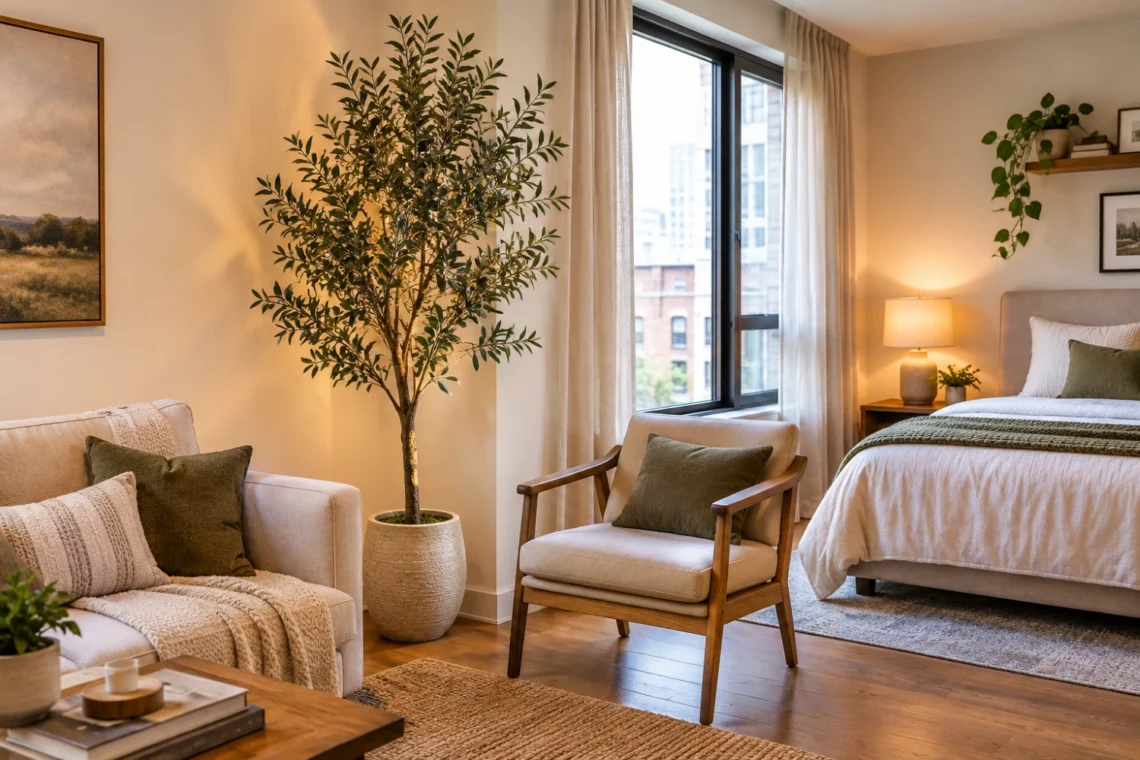
Decorating advice for small apartments tends to circle the same handful of rules: fewer pieces, lighter colors, furniture that pulls double duty. It’s sound advice, but it skips over one of the simplest ways to make a cramped room feel finished instead of merely empty — a single, well-placed statement tree.
The idea sounds backward at first. Adding a five- or six-foot tree to a room already short on square footage seems like the opposite of restraint. In practice, it’s often the one move that makes a small space read as intentional rather than sparse.
Why Small Rooms Read as Unfinished, Not Minimal
There’s a particular kind of emptiness that shows up in small apartments, and it isn’t the same as the emptiness of a deliberately minimalist room. A minimalist space has negative space by design — every remaining object earns its place. A small apartment usually ends up with negative space by default, because there wasn’t the budget, the time, or the square footage left to finish a corner properly.
The result reads as unfinished rather than calm, and guests can usually sense the difference even without being able to name it.
A tall plant closes that gap about as efficiently as anything can. It adds height, texture, and life to a corner without adding clutter or eating into floor space the way a second chair or console table would.
Why Height Matters More Than Footprint
The instinct in a small room is to buy small — a compact plant that stays out of the way. This tends to backfire. A short plant in a small room just becomes one more low object in a room already crowded with them: a coffee table, a floor cushion, a side table.
A tall, narrow tree does something else entirely. It pulls the eye upward, which makes the ceiling feel higher and the room feel larger — the same trick floor-length curtains or vertical shelving pull off. The floor footprint of a five-foot tree is often no bigger than a side table’s, yet the effect on the room is nothing alike.
What to Look For in a Small-Space Tree
- A narrow, upright silhouette. Tall but slim beats wide and bushy for fitting into a corner without eating into walking space. A slender option like a Tuscan Olive tends to work especially well here.
- A trunk with some visual interest. A plant in a small room gets viewed up close far more often than across a large one, so trunk detail carries more weight than it would in a sprawling living room.
- A pot sized to the room, not the tree. An oversized planter eats up floor space for no real benefit; a well-proportioned pot keeps the whole footprint tight.
Where One Tree Changes the Whole Room
A few spots in a small apartment consistently reward a single, well-chosen tree.
The Empty Corner Behind the Couch
This is usually the deadest zone in a small living room — too awkward for furniture, too visible to ignore. A tall tree fills it without a trip to a furniture store.
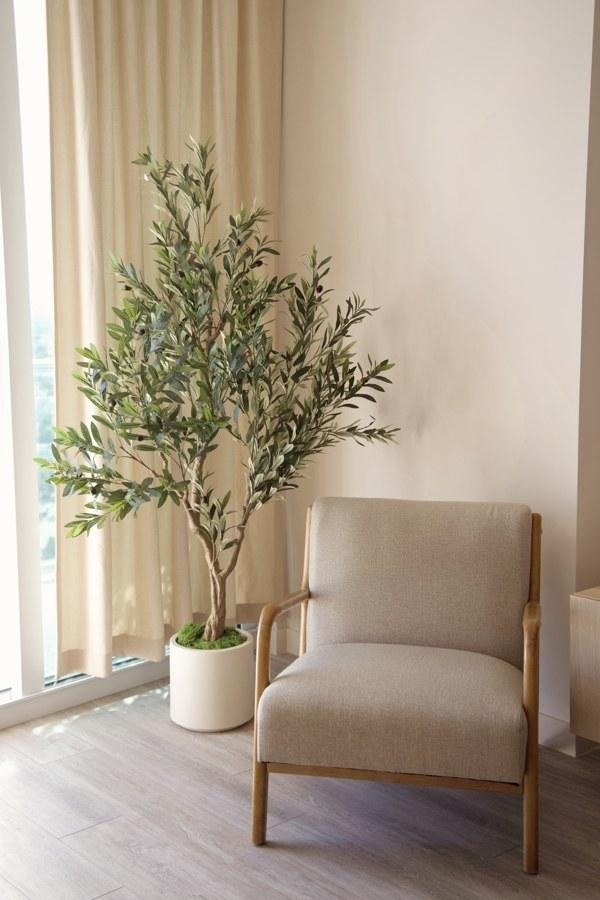
A faux olive tree filling a corner beside an accent chair
A real customer’s corner, solved with one tree instead of another piece of furniture. It fills the height between floor and ceiling without crowding the chair beside it — exactly the empty-corner problem this section is describing.
Beside a Window With an Unremarkable View
Not every window frames something worth looking at. A tree placed just to the side gives the eye somewhere better to land than a parking lot or a neighbor’s wall.
The Foot of a Bed in a Studio
In a studio, the bed often has to double as the room’s visual anchor. A tree at its foot — clear of the walking path — adds scale and softness without touching the floor plan.
A Few Styling Details That Make the Difference
Once the right tree is in place, a handful of small decisions separate a considered room from an afterthought:
- Angle it toward the room, not the wall. Most trees have a fuller “best side.” Turning that side outward, instead of centering the tree squarely, reads as more natural and less like a display piece.
- Let a branch or two break the silhouette. A perfectly symmetrical canopy can look slightly artificial at close range. Gently bending one or two lower branches outward, where the stems allow it, breaks up that symmetry.
- Skip the matching plant stand. In a small room, extra furniture under the pot usually adds clutter rather than solving it. Letting the pot sit directly on the floor keeps the footprint minimal.
- Add one smaller plant nearby, not a cluster. A single trailing pothos on a shelf echoes the greenery without competing with the tree for attention.
None of this costs more than a few minutes of arranging, but it’s often the difference between a tree that looks placed and one that looks like it’s always belonged there.
Real Faux, Not Recognizably Faux
The one real caveat with small-space styling is proximity. In a large room, a mediocre faux tree can get away with looking slightly off, because no one examines it closely. In a small apartment, that same tree might sit three feet from the couch — close enough that every seam in the trunk and every unnaturally glossy leaf becomes obvious.
This is where the newer generation of faux trees earns its keep. Pieces like the ones from Rootless Plants are built with hand-finished bark and individually placed leaves precisely because they’re meant to be seen up close, not admired from across a showroom floor. In a small space, that close-range realism isn’t a nice-to-have. It’s the entire point.
A Small Investment, Disproportionate Payoff
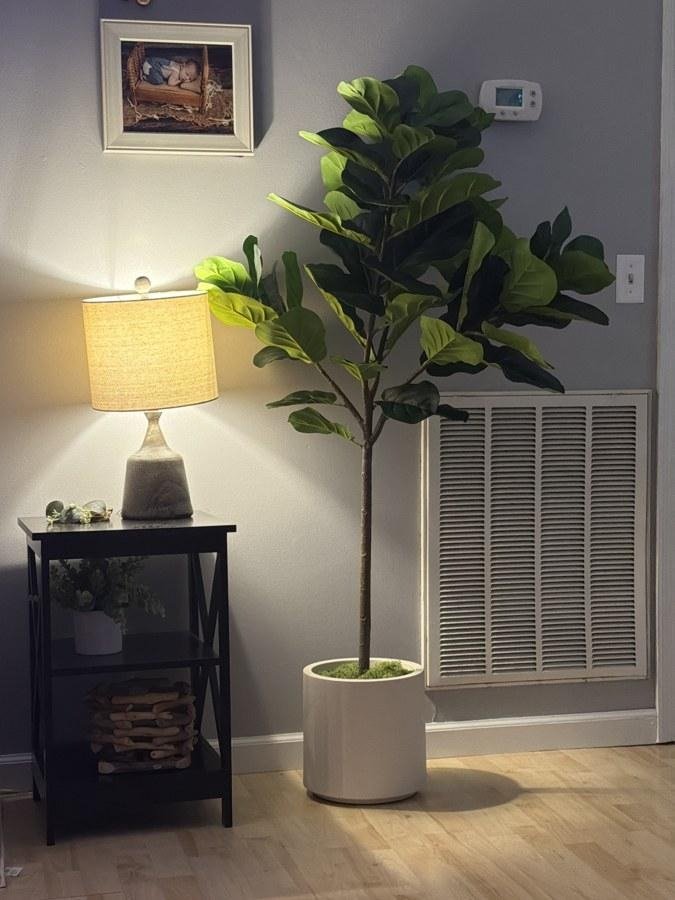
A faux fiddle-leaf fig beside a lit lamp in a cozy corner
A small, warmly lit corner — a lamp, a side table, and a fiddle-leaf fig doing the job an entire extra piece of furniture might otherwise have had to do. It’s a modest setup, but it’s exactly the kind of corner that makes a small room feel finished rather than sparse.
Of all the ways to improve a small apartment, a well-chosen tree is one of the rare ones that’s a single investment rather than an ongoing one — no rearranged furniture, no structural changes, no monthly upkeep. It simply sits in its corner and does the quiet work of making the room feel considered instead of compromised.
For anyone renting a space that already feels tight, that’s a fair trade: one modest, well-placed piece, in exchange for a room that finally looks finished.